Building an Automated Appointment Booking AI Voice Assistant with Vapi, Twilio, and Cal.com
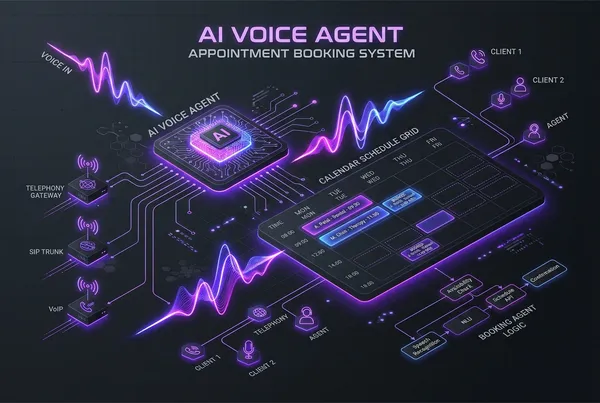
Missed calls cost service-based businesses thousands of dollars in lost revenue every month. Whether it’s a dental practice, real estate agency, law firm, or B2B consultancy, over 60% of potential clients will not leave a voicemail—they simply hang up and call a competitor. Hiring 24/7 front-desk staff or third-party call centers is expensive, prone to human error, and rarely scales. With modern conversational Voice AI, we can deploy an **Autonomous AI Voice Receptionist** that answers incoming calls within one ring, answers complex business questions conversationally, checks live calendar availability, and books appointments directly into your schedule—with zero human intervention. In this guide, I will break down the end-to-end architecture for building an automated booking voice agent using **Vapi**, **Twilio**, and **Cal.com**. --- ## High-Level System Architecture ``` Caller (Phone/PSTN) │ ▼ ┌──────────────┐ │ Twilio Voice │ (Inbound SIP Trunk / Carrier Gateway) └──────┬───────┘ │ Bidirectional Audio Stream ▼ ┌──────────────┐ │ Vapi AI │ (STT: Deepgram Nova-2 + LLM: GPT-4o / Claude + TTS: Cartesia) └──────┬───────┘ │ Function / Tool Calling Webhook ▼ ┌──────────────┐ │ FastAPI / │ (Middleware: Timezone normalization & Slot Validation) │ n8n Webhook │ └──────┬───────┘ │ REST API ▼ ┌──────────────┐ │ Cal.com API │ (Real-Time Slot Availability & Event Creation) └──────┬───────┘ │ ├──> Google Calendar / Outlook Sync ├──> Twilio SMS Confirmation to Caller └──> CRM Update (HubSpot, GoHighLevel, Supabase) ``` --- ## 1. The Real-Time Voice Pipeline (Vapi) A voice bot must feel natural. If the caller experiences a 2-second pause after speaking, the illusion breaks. Vapi orchestrates the low-latency triangle: 1. **Speech-to-Text (STT)**: Deepgram Nova-2 with streaming transcripts (sub-150ms). 2. **Intelligence (LLM)**: GPT-4o mini or Claude 3.5 Haiku with streaming tokens and strict tool calling definitions. 3. **Text-to-Speech (TTS)**: Cartesia Sonic or ElevenLabs Turbo v2.5 delivering natural emotional inflection and immediate audio buffering. Vapi handles **barge-in** out of the box. When the caller interrupts the AI ("Wait, do you have anything after 3 PM instead?"), Vapi instantly cancels the active audio buffer and re-prompts the model. --- ## 2. Defining the Tool Calling Schema To allow the voice agent to interact with your booking engine, we configure two distinct server-side tools in Vapi: ### Tool 1: `check_available_slots` Triggered when the caller asks about availability: ```json { "name": "check_available_slots", "description": "Checks available calendar booking slots for a given date range.", "parameters": { "type": "object", "properties": { "date": { "type": "string", "description": "Target date in YYYY-MM-DD format (e.g., 2026-11-04)" }, "timezone": { "type": "string", "description": "Caller timezone, defaults to America/New_York" } }, "required": ["date"] }, "server": { "url": "https://api.yourdomain.com/v1/voice/slots" } } ``` ### Tool 2: `book_appointment` Triggered once the caller confirms a specific date, time, and contact information: ```json { "name": "book_appointment", "description": "Reserves and confirms an appointment on Cal.com.", "parameters": { "type": "object", "properties": { "start_time": { "type": "string", "description": "ISO 8601 timestamp of chosen slot (e.g. 2026-11-04T15:00:00Z)" }, "caller_name": { "type": "string", "description": "Full name of the caller" }, "caller_phone": { "type": "string", "description": "Phone number for SMS reminder" }, "caller_email": { "type": "string", "description": "Email address for calendar invite" } }, "required": ["start_time", "caller_name", "caller_phone"] }, "server": { "url": "https://api.yourdomain.com/v1/voice/book" } } ``` --- ## 3. Implementing the Middleware with FastAPI & Cal.com API Here is how the backend webhook handler processes slot checks and books the appointment in Python: ```python from fastapi import FastAPI, HTTPException from pydantic import BaseModel import httpx import os app = FastAPI() CALCOM_API_KEY = os.getenv("CALCOM_API_KEY") EVENT_TYPE_ID = int(os.getenv("CALCOM_EVENT_TYPE_ID", "124801")) @app.post("/v1/voice/slots") async def check_slots(payload: dict): target_date = payload["message"]["toolCalls"][0]["function"]["arguments"]["date"] async with httpx.AsyncClient() as client: res = await client.get( f"https://api.cal.com/v2/slots/available", params={ "eventTypeId": EVENT_TYPE_ID, "startTime": f"{target_date}T00:00:00Z", "endTime": f"{target_date}T23:59:59Z", }, headers={"Authorization": f"Bearer {CALCOM_API_KEY}"} ) slots_data = res.json().get("data", {}).get("slots", {}) available_times = [slot["time"] for slot in slots_data.get(target_date, [])] if not available_times: return {"result": f"No available openings on {target_date}. Suggest alternative dates."} # Return formatted readable times for the voice agent readable_slots = [t.split("T")[1][:5] for t in available_times[:3]] return {"result": f"Available times on {target_date}: {', '.join(readable_slots)}"} ``` --- ## 4. Post-Call Automation & SMS Follow-Up The customer experience shouldn’t stop when the phone call ends: 1. **Vapi End-of-Call Webhook**: Fires immediately upon hang-up with structured variables (`duration`, `recording_url`, `transcript`, `summary`). 2. **Instant SMS via Twilio**: > *"Hi John! Your appointment with Dr. Miller is confirmed for Wednesday, Nov 4 at 3:00 PM. Here is your calendar link: cal.com/b/98124. Reply STOP to cancel."* 3. **CRM Sync**: Updates contact records in HubSpot, GoHighLevel, or Salesforce, tagging the lead source as `Voice AI Receptionist`. --- ## 5. Production Hardening: Avoiding Common Pitfalls - **Timezone Discrepancies**: Never let the LLM guess UTC offsets. Always enforce explicit timezones in the system prompt based on the Twilio phone number prefix or customer profile. - **Race Conditions**: If two callers attempt to book the same slot simultaneously, handle Cal.com `409 Conflict` gracefully with a fallback: *"That slot was just claimed a moment ago. How does 3:30 PM sound instead?"* - **Human Transfer Fallbacks**: If the caller expresses frustration or requests human assistance, trigger an immediate SIP transfer (`transferCall` action) to route the call to a human supervisor. --- ## Ready to Deploy a Voice AI Agent for Your Business? I help companies, clinics, and agencies design and deploy **custom, high-conversion Voice AI agents** that run 24/7 without dropped calls or awkward pauses. If you want to automate your inbound bookings, qualify leads automatically, or integrate telephony into your CRM: 👉 **[Book a Discovery Call](/#contact)** or email me directly at **[[email protected]](mailto:[email protected]?subject=Voice%20AI%20Booking%20Assistant%20Project)** to discuss your architecture.